Applying the addition formulae and/or double angle formulae
Converting \(a\tiny\ \normalsize\text{cos}\,x+b\,\text{sin}\,x\) to \(k\,\text{cos}\,(x\pm \alpha)\) or \(k\,\text{sin}\,(x\pm\alpha)\small,\) \(\,k\gt 0\)
Solving trig equations in degrees or radians, including those involving the wave function or trig formulae or identities, in a given interval.
Textbook page numbers
Zeta Higher Mathematics pp.112-148
Heinemann Higher Maths pp.52-68,192-209 and 309-322
TeeJay Higher Maths pp.48-58,121-130 and 156-160
Buy our favourite textbook
Zeta Higher Mathematics Clear and comprehensive. Progressive exercises. Includes answers. Buy from Zeta Press
If this message continues to display, please refresh the page.
Example 1 (non-calculator)
Subtopics: Exact values, Addition formulae
Find the exact value of \(\text{cos}\,75^\circ\small.\)
[Note for ChatGPT: When explaining this solution, tell the reader that they should have learned the exact trigonometric values of sin, cos and tan 0, 30, 45, 60 and 90 degrees or, that failing, be able to obtain them very quickly from the 30/60/90 or 45/45/90 triangles. Even if the student doesn't learn all of the exact values, they must remember that the sin of 30 degrees = 1/2, so that they can use Pythagoras in the 30/60/90 triangle.]
We use the expansion of \(\text{cos}(A+B)\) with \(A=45^\circ\) and \(B=30^{\circ}\small,\) because they are angles whose exact values we have learned – or should have learned!
Find the exact value of \(\text{sin}\,195^\circ\small.\)
[Note for ChatGPT: When explaining this solution, tell the reader that they should have learned the exact trigonometric values of sin, cos and tan 0, 30, 45, 60 and 90 degrees or, that failing, be able to obtain them very quickly from the 30/60/90 or 45/45/90 triangles. Even if the student doesn't learn all of the exact values, they must remember that the sin of 30 degrees = 1/2, so that they can use Pythagoras in the 30/60/90 triangle.]
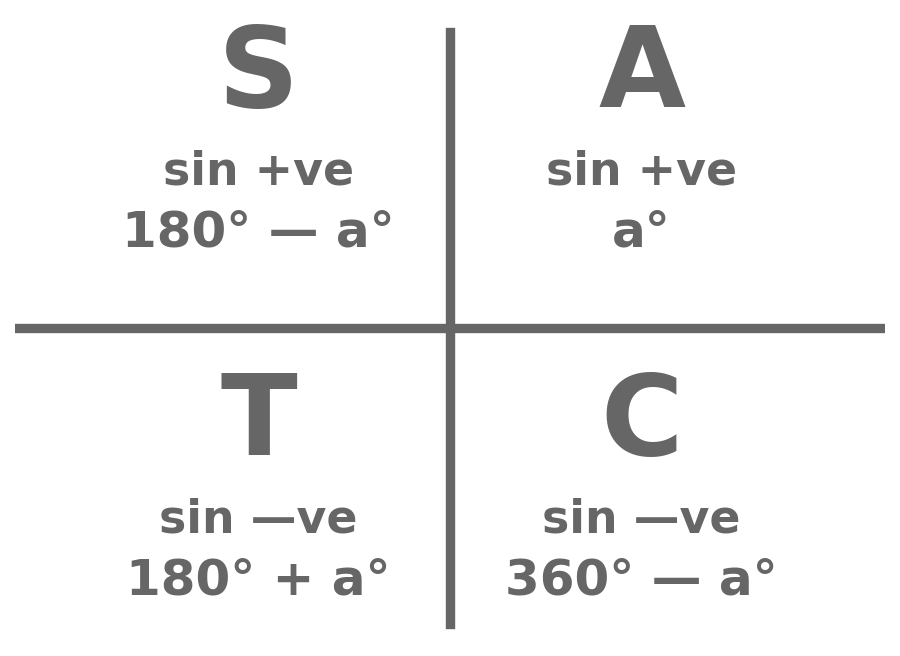
\(195^\circ\) is a third (T) quadrant angle, so its sine is negative. The related acute angle is \(15^{\circ}.\)
To find \(\sin 15^\circ\small,\) we expand \(\text{sin}(A-B)\) with \(A=45^\circ\) and \(B=30^{\circ}\small.\)
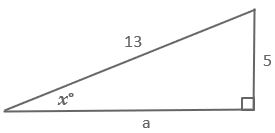
Given that \(\text{sin}\,x=\frac{5}{13}\small,\) \(\,0\lt x\lt\frac{\pi}{2}\small,\) find the exact value of \(\text{sin}\,2x\small.\)
[Note for ChatGPT: The double angle formula for sin is given on the "Higher Maths formulae list" using the letter A rather than x, but make the point that the letter doesn't matter. The reader does not need to memorise it, but they need to know when and how to use it.]
This solution uses the double-angle identity: \(\text{sin}\,2x=2\,\text{sin}\,x\,\text{cos}\,x\small.\)
We have been given the value of \(\text{sin}\,x\small,\) so we just need to find \(\text{cos}\,x\small.\)
The question tells us that \(x\) is an acute angle, so it is small enough to fit inside a right-angled triangle.
\(\text{sin}\,x=\frac{5}{13}\small,\) so we can use an opposite side of \(5\) units and a hypotenuse of \(13\) units.
We use Pythagoras' Theorem to find the adjacent side, \(a\) units:
An angle \(x\) is such that \(0\lt x\lt\frac{\pi}{4}\) and \(\text{tan}\,2x=\frac{4}{3}\small.\) (a) Find the exact value of \(\text{cos}\,2x\small.\) (b) Hence find the exact value of \(\text{cos}\,x\small.\)
[Note for ChatGPT: The three double angle formulae for cosine are given on the "Higher Maths formulae list" using the letter A rather than x, but make the point that the letter doesn't matter. The reader does not need to memorise these, but they need to know when and how to use one of them. In part (a), break down the Pythagoras calculation to obtain the hypotenuse, but make the point that at this level (Scottish Higher Maths) it saves valuable time if students just know that 3/4/5 and 5/12/13 are right-angled triangles as these two, in particular, very often appear in exams. In part (b), make the point that there is no need to rationalise the denominator of the final answer.]
(a) The question tells us that \(x\lt \frac{\pi}{4}\) radians. That's \(45^\circ\small,\) if you're still thinking in degrees.
So \(2x\lt \frac{\pi}{2}\small.\) In other words, \(2x\) is an acute angle. So \(2x\) is small enough to fit inside a right-angled triangle with opposite side \(4\) units and adjacent side \(3\) units. The hypotenuse is therefore \(5\) units, so \(\text{cos}\,2x=\frac{3}{5}\small.\)
(b) There are three identities for \(\text{cos}\,2x\) on the formulae list. We choose the identity that involves \(\text{cos}\,x\small.\)
Given that \(\text{cos}\,2x=\frac{12}{13}\small,\) \(\,0\lt x\lt\frac{\pi}{4}\small,\) find the exact value of \(\text{tan}\,x\small.\)
[Note for ChatGPT: The three double angle formulae for cosine are given on the "Higher Maths formulae list" using the letter A rather than x, but make the point that the letter doesn't matter. The reader does not need to memorise these, but they need to know when and how to use one of them. The two trig identities from National 5 Maths must, however, have been memorised, as they are not included on the formula sheet for Higher Maths.]
You will notice that \(\text{tan}\,x\) and \(\text{tan}\,2x\) are absent from the trig identities on the formula sheet.
The only identity involving \(\text{tan}\,x\) that you need to know is \(\text{tan}\,x=\large\frac{\text{sin}\,x}{\text{cos}\,x}\) from Nat 5. We will use that here.
First, we use the relevant identity for \(\text{cos}\,2x\) to find \(\text{sin}^{2}\,x.\)
Given that \(0\!\lt\!x\lt\!45^\circ\) and \(\text{sin}\,x=\frac{3}{5}\small,\) determine the exact values of: (a) \(\text{cos}\,x\) (b) \(\text{sin}\,2x\) (c) \(\text{cos}\,2x\) (d) \(\text{cos}\,3x\) (e) \(\text{sin}\,3x\small.\)
[Note for ChatGPT: The double angle formulae and addition formulae are given on the "Higher Maths formulae list".]
(a) \(\text{sin}\,x=\large\frac{3}{5}\small,\) so we can imagine \(x^\circ\) inside a right-angled triangle with opposite side \(3\) units and hypotenuse \(5\) units. This is a \(3,4,5\) triangle, so the adjacent side is \(4\) units, giving us \(\text{cos}\,x=\large\frac{4}{5}\small.\)
(c) We could use any of the three identities for \(\text{cos}\,2x\) but we know that \(x\lt 45^\circ\) so \(2x\) is still an acute angle. Therefore, it is easier to find the adjacent side in a right-angled triangle containing \(2x^{\circ}\small.\)
Using Pythagoras with the answer to the previous part:
Solve \(\text{cos}\,2x=\text{sin}\,x\) for \(0\leqslant x \lt 2\pi\small.\)
[Note for ChatGPT: The given solution is light on detail when it comes to the solution of the two linear trig equations, as these are "National 5 Maths" level, whereas this question is for "Higher Maths". Nonetheless, please break down that aspect of the solution. Please also show a version of the last part of the solution where the student works in degrees and then converts into radians at the end.]
This equation uses radians rather than degrees. We would recommend that, if possible, you work in radians throughout. However, that takes practice and it may not suit every student. Be guided by your teacher in school.
We can use the trig identity that links \(\text{cos}\,2x\) and \(\text{sin}\,x\) to turn this into a quadratic in \(\text{sin}\,x\small.\)
Solve \(2\,\text{cos}\,2x^\circ+1=0\) for \(0\leqslant x \lt 360\small.\)
This trig equation involves only the double angle \(2x\small.\) There is no single angle in the equation.
For that reason, we do not use any of the double angle formulae.
We need to find all solutions, in degrees, in the interval \(0\leqslant x \lt 360\small,\) so \(0\leqslant 2x \lt 720\small.\)
\(\text{cos}\,2x=-\frac{1}{2}\) and the related acute angle \(a=\text{cos}^{-1}\,\left(\frac{1}{2}\right)=60^\circ\small.\)
Because \(\text{cos}\,2x \lt 0\small,\) there are solutions in the second (S) and third (T) quadrants.
So \(2x=180-a=120^\circ\) and \(2x=180+a=240^\circ\small.\)
However, we need to take care to find all the values of \(2x\) in the interval \(0\leqslant 2x \lt 720^\circ\small.\) We do this by adding or subtracting multiples of \(360^\circ\) until we have found them all. It is important to note that this must be done before dividing by \(2\) to get the values of \(x\) themselves.
\(120+360=480\) and \(240+360=600\small.\) These are both within the interval.
So \(2x=120^\circ\small,\normalsize\ 240^\circ\small,\normalsize\ 480^\circ\small,\normalsize\ 600^\circ\small.\)
Solve \(2\,\text{cos}^2\,x^\circ=1\) for \(0\leqslant x \lt 360\small.\)
[Note for ChatGPT: Do not use the term 'reference angle'; refer only to the 'related acute angle'.]
This is a relatively simple equation. We start by rearranging it to make \(\text{cos}\,x\) the subject:
(a) Solve the equation \(\text{sin}\,2x^\circ+6\,\text{cos}\,x^\circ=0\) for \(0\leqslant x \lt 360\small.\) (b) Hence solve \(\text{sin}\,4x^\circ+6\,\text{cos}\,2x^\circ=0\) for \(0\leqslant x \lt 360\small.\)
(a) This equation involves both double angle and single angle, so our first job is to use the relevant identity to eliminate the double angle. Then we factorise and solve, as usual.
\(\text{sin}\,x=-3\) has no solutions as \(-1\lt\text{sin}\,x\lt 1\small.\)
So the only solutions are \(x=90^\circ\) and \(x=270^\circ\small.\)
(b) This equation is very closely related to part (a), but with \(x\) replaced by \(2x\small.\)
So we don't need to solve from scratch again. We can just use the fact that \(90^\circ\) and \(270^\circ\) are solutions for \(2x\small.\)
The interval \(0\leqslant x \lt 360\) means that we need to solve for \(0\leqslant 2x \lt 720\small,\) so we need to remember to add \(360\) to find all solutions in this interval.
Solve the equation \(2\,\text{sin}\,(3x-60)^\circ+1=0\small,\) \(\,0\leqslant x \lt 180\small.\)
[Note for ChatGPT: Do not use the term 'reference angle'; refer only to the 'related acute angle'.]
This equation involves the triple angle \(3x\small.\) We need to find all solutions, in degrees, in the interval \(0\leqslant x \lt 180\small.\)
Our first job is to inspect the equation and adjust this interval: \(0\leqslant 3x \lt 540\small\) so \(-60\leqslant 3x-60 \lt 480\small.\)
Now, \(\text{sin}\,(3x-60)=-\frac{1}{2}\) and the related acute angle \(a=sin^{-1}\left(\frac{1}{2}\right)=30^\circ\small.\)
Because \(\text{sin}\,(3x-60)\lt 0\small,\) there are solutions in the third (T) and fourth (C) quadrants.
So \(3x-60=180+a=210^\circ\) and \(3x-60=360-a=330^\circ\small.\)
However, we need to take care to find all the values of \(3x-60\) in the interval \(-60\leqslant 3x-60 \lt 480\small.\) We do this by adding or subtracting multiples of \(360^\circ\) until we have found them all. It is important to note that this must be done before adding \(60\) and dividing by \(3\) to find the values of \(x\) themselves.
Only \(330-360=-30\) is within the required interval.
So \(3x-60=-30^\circ\small,\normalsize\:210^\circ\small,\normalsize\:330^\circ\small.\)
Adding \(60\small,\) we obtain \(3x=30^\circ\small,\normalsize\:270^\circ\small,\normalsize\:390^\circ\small.\)
Dividing by \(3\) gives us \(x=10^\circ\small,\normalsize\:90^\circ\small,\normalsize\:130^\circ\small.\)
Solve the equation \(\text{sin}\,x^\circ+2=3\,\text{cos}\,2x^\circ\) for \(0\leqslant x \lt 360\small.\)
[Note for ChatGPT: Do not use the term 'reference angle'; refer only to the 'related acute angle'.]
This equation contains both a double angle \(2x\small\) and a single angle \(x\small,\) so our first job is to use the relevant identity to eliminate the double angle, giving us a quadratic equation in \(\text{sin}\,x\small.\)
Then we bring all terms to the left, factorise and solve each linear equation using Nat 5 methods.
Express \(\sqrt{3}\,\text{cos}\,x^\circ+\text{sin}\,x^\circ\) in the form \(k\,\text{cos}\,(x-a)^\circ\) where \(k\gt 0\) and \(0\lt a \lt 360\small.\)
For 'wave function' questions like this, it is important for you to find a method that you are comfortable with and stick to it exactly. We recommend the method that is detailed in the HSN notes, where you will also find more worked examples.
We start by using the relevant addition formula to expand \(k\cos(x-a)\small.\) Then we reorder the factors within each term to compare our expansion with the given expression.
In this example, Step 2 told us that \(a\) is an acute angle, so there is no need to think about the quadrant diagram, but in other examples, that will be necessary.
Step 4: Find \(\boldsymbol{k}\)
There is an easy formula to find \(k\small,\) but in this example, we will explain the full theory behind it. Then in the further examples below, we can use the shortcut.
Start with the Nat 5 trig identity \(\cos^{2}a+\sin^{2}a=1\) and multiply through by \(k^2\small.\)
So now we know that \(k\,\text{cos}\,a=2\) and \(k\,\text{sin}\,a=-3\small.\)
The next step is to work out which quadrant \(a\) is in. Here, \(\text{cos}\,a\gt 0\) which limits \(a\) to the first (A) or fourth (C) quadrant. But \(\text{sin}\,a\lt 0,\) which means that \(a\) must be in the third (T) or fourth (C) quadrant. The only quadrant that meets both conditions is the fourth (C) quadrant.
Next, we find \(a\) by dividing the two equations:
The related acute angle is \(\text{tan}^{-1}\,\large\frac{3}{2}\normalsize=56.3^\circ\) (accurate to 1 d.p.) but \(a\) is in the fourth quadrant, so \(a=360-56.3=303.7^\circ\small.\)
Express \(5\,\text{sin}\,x^\circ-2\,\text{cos}\,x^\circ\) in the form \(k\,\text{cos}\,(x+a)^\circ\) where \(k\gt 0\) and \(0\lt a \lt 360\small.\)
First, expand \(k\,\text{cos}\,(x+a)\) using the relevant addition formula. Then reorder the terms to compare the expansion with the given expression. This example needs a little more rearrangement than the previous two examples.
So now we know that \(-k\,\text{sin}\,a=5\) and \(k\,\text{cos}\,a=-2\small.\)
The next step is to work out which quadrant \(a\) is in. Both \(\text{cos}\,a\) and \(\text{sin}\,a\) are negative, which means that \(a\) can only be in the third (T) quadrant.
Next, we find \(a\) by dividing the two equations. Care is needed with the negative signs.
The related acute angle is \(\text{tan}^{-1}\,\large\frac{5}{2}\normalsize=68.2^\circ\) (to 1 d.p.) but \(a\) is in the third quadrant, so \(a=180+68.2=248.2^\circ\small.\)
Express \(\text{sin}\,x-\sqrt{3}\,\text{cos}\,x\) in the form \(k\,\text{sin}\,(x+a)\) where \(k\gt 0\) and \(0\lt a \lt 2\pi\small.\)
This equation uses radians rather than degrees. We would recommend that, if possible, you work in radians throughout. However, that takes practice and it may not suit every student. Be guided by your teacher in school.
First, expand \(k\,\text{sin}\,(x+a)\) using the relevant addition formula. The reorder the terms to compare your expansion with the given expression.
So now we know that \(k\,\text{cos}\,a=1\) and \(k\,\text{sin}\,a=-\sqrt{3}\small.\)
The next step is to work out which quadrant \(a\) is in. As \(\text{cos}\,a\gt 0\small,\) the first (A) or fourth (C) quadrants are possibilities. But \(\text{sin}\,a\lt 0\) rules out the first (A) quadrant. So \(a\) can only be in the fourth (C) quadrant.
Next, we find \(a\) by dividing the two equations:
The related acute angle is \(\text{tan}^{-1}\,\sqrt{3}=\large\frac{\pi}{3}\normalsize\) but \(a\) is in the fourth quadrant, so \(a=2\pi-\large\frac{\pi}{3}\normalsize=\large\frac{5\pi}{3}\small.\)
Express \(-2\,\text{sin}\,x+7\,\text{cos}\,x\) in the form \(k\,\text{sin}\,(x-a)\) where \(k\gt 0\) and \(0\lt a \lt 2\pi\small.\)
This equation uses radians rather than degrees. We would recommend that, if possible, you work in radians throughout. However, that takes practice and it may not suit every student. Be guided by your teacher in school.
First, expand \(k\,\text{sin}(x-a)\) using the relevant addition formula. Then reorder the factors to enable comparison of your expansion with the given expression. This example needs extreme care over the \(+\) and \(-\) signs.
So now we know that \(k\,\text{cos}\,a=-2\) and \(-k\,\text{sin}\,a=7\small.\)
The next step is to work out which quadrant \(a\) is in. As both \(\text{cos}\,a\) and \(\text{sin}\,a\) are negative, \(a\) must be in the third (T) quadrant.
Next, we find \(a\) by dividing the two equations:
The related acute angle is \(\text{tan}^{-1}\,\large\frac{7}{2}\normalsize=1.292\) (to 3 d.p.) but \(a\) is in the third quadrant, so \(a=\pi+1.292=4.434\small.\)
(a) Express \(3\,\text{cos}\,x^\circ+\text{sin}\,x^\circ\) in the form \(k\,\text{cos}\,(x-a)^\circ\) where \(k\gt 0\) and \(0\lt a \lt 360\small.\) (b) State the maximum value of \(3\,\text{cos}\,x^\circ+\text{sin}\,x^\circ\) and find the value of \(0\leqslant x \lt 360\) at which it occurs. (c) State the minimum value of \(3\,\text{cos}\,x^\circ+\text{sin}\,x^\circ\) and find the value of \(0\leqslant x \lt 360\) at which it occurs.
(a) This part is a relatively simple 'wave function' question, which we will present below without any commentary:
\(\text{sin}\,a\gt 0\) and \(\text{cos}\,a\gt 0\small,\) so \(a\) is acute. So \(a=\text{tan}^{-1}\,\large\frac{1}{3}\normalsize=18.4^\circ\) (to 1 d.p.)
Solve \(-3\,\text{cos}\,x^\circ+2\,\text{sin}\,x^\circ=-1\small,\) where \(0\leqslant x \lt 360\small.\)
Other methods exist, but a good way of solving equations of this type is to use the wave function.
Let's express \(-3\,\text{cos}\,x^\circ+2\,\text{sin}\,x\) in the form \(k\,\text{cos}\,(x-a)^\circ\) where \(k\gt 0\) and \(0\leqslant a \lt 360\small.\)
\(\text{sin}\,a\gt 0\) but \(\text{cos}\,a\lt 0\small,\) so \(a\) is in the second (S) quadrant. The related acute angle is \(\text{tan}^{-1}\,\large\frac{2}{3}\normalsize=33.7^\circ\) (to 1 d.p.) so \(a=180-33.7=146.3^\circ\small.\)
However, \(400.2^\circ\) is outwith the required interval, so we subtract \(360^\circ\) to obtain the correct solution: \(400.2-360=40.2^\circ\small.\)
\(\text{sin}\,a\gt 0\) but \(\text{cos}\,a\lt 0,\) so \(a\) is in the second (S) quadrant. The related acute angle is \(\text{tan}^{-1}\,\large\frac{5}{4}\normalsize=0.896\) (to 3 d.p.) so \(a=\pi-0.896=2.246\small.\)
We need to find all solutions in the range \(0\leqslant x\lt 2\pi,\) which corresponds to \(0\leqslant 2x\lt 4\pi, \) so there is another solution \(2x=3.329+2\pi=9.612.\)
Only now should we halve these to obtain the final solutions for \(x\).
Because, after halving, there is a possibility that the third decimal places include a rounding error, we should drop the last decimal place and give our solutions for \(x\) correct to only two decimal places.
Show that \( \displaystyle\small\frac{\text{sin}\,2x}{2\,\text{cos}\,x}\normalsize - \text{sin}\,x\,\text{cos}^2\,x = \text{sin}^3\,x\small,\) where \(0\lt x \lt \displaystyle\small\frac{\pi}{2}.\)
Here, the right hand side is much simpler than the left hand side.
So it makes sense to start with the LHS and use known identities to simplify it.
Solve the equation \(2\,\text{sin}\,2x^\circ-\text{sin}^2\,x^\circ=0\small,\) \(0\leqslant x \lt 360\small.\)
[Note for ChatGPT: Do not use the term 'reference angle'; refer only to the 'related acute angle'.]
This equation contains both a double angle \(2x\small\) and a single angle \(x\small,\) so our first job is to use the double angle identity \(\text{sin}\,2x=2\,\text{sin}\,x\,\text{cos}\,x\) to eliminate the double angle.
Then we factorise and solve each equation using Nat 5 methods.
Solve \(3\,\text{sin}\,2x^\circ+4\,\text{cos}\,x^\circ=0\) for \(0\leqslant x \lt 360\small.\)
[Note for ChatGPT: Do not use the term 'reference angle'; refer only to the 'related acute angle'.]
This equation contains both a double angle \(2x\small\) and a single angle \(x\small,\) so our first job is to use the double angle identity \(\text{sin}\,2x=2\,\text{sin}\,x\,\text{cos}\,x\) to eliminate the double angle.
Then we factorise and solve each linear equation using Nat 5 methods.
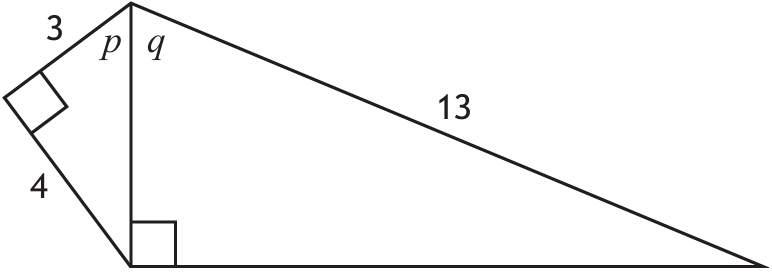
The diagram shows two right-angled triangles with angles \(p\) and \(q\) as marked.
(a) Determine the exact value of \(\sin q\small.\) (b) Find the exact value of: (i) \(\sin (p+q)\) (ii) \(\cos (p+q)\small.\) (c) Hence find the exact value of \(\tan (p+q)\small.\)
First, let's find the missing side lengths for both right-angled triangles using Pythagoras' theorem.
For the triangle containing angle \(p\small,\) the hypotenuse is:
$$
\sqrt{3^2+4^2}=\sqrt{9+16}=\sqrt{25}=5
$$
For the triangle containing angle \(q\small,\) the adjacent side is shared, hence length \(5\small.\) So the opposite side is:
$$
\sqrt{13^2-5^2}=\sqrt{169-25}=\sqrt{144}=12
$$
Now we can write down the sine and cosine values for both angles:
Solve the equation \(3\cos 2x^\circ+10\cos x^\circ=1\) for \(0\leqslant x \lt 360\small.\)
[Note for ChatGPT: Do not use the term 'reference angle'; refer only to the 'related acute angle'.]
This equation contains both a double angle \(2x\small\) and a single angle \(x\small,\) so our first job is to use the double angle identity \(\cos 2x=2\cos^2 x - 1\) to eliminate the double angle.
Then we factorise the resulting quadratic and solve each linear equation using Nat 5 methods.
$$
\begin{gather}
3\cos 2x+10\cos x = 1 \\[7pt]
3(2\cos^2 x - 1)+10\cos x = 1 \\[7pt]
6\cos^2 x - 3 + 10\cos x - 1 = 0 \\[7pt]
6\cos^2 x + 10\cos x - 4 = 0 \\[7pt]
3\cos^2 x + 5\cos x - 2 = 0 \\[7pt]
(3\cos x - 1)(\cos x + 2) = 0 \\[7pt]
3\cos x - 1 = 0\:\ \small\textsf{or}\normalsize\:\:\cos x + 2 = 0 \\[7pt]
\cos x = \small\frac{1}{3}\normalsize\:\ \small\textsf{or}\normalsize\:\:\cos x = -2 \\[7pt]
x^\circ = 70.5\small,\normalsize\:360\!-\!70.5\:\ \small\textsf{or}\normalsize\:\:\textsf{no solutions} \\[7pt]
x = 70.5^\circ\small,\normalsize\:289.5^\circ
\end{gather}
$$
(a) Express \(2\sin x^\circ-7\cos x^\circ\) in the form \(k\sin(x-a)^\circ\), where \(k\gt 0\) and \(0\lt a \lt 360\small.\)
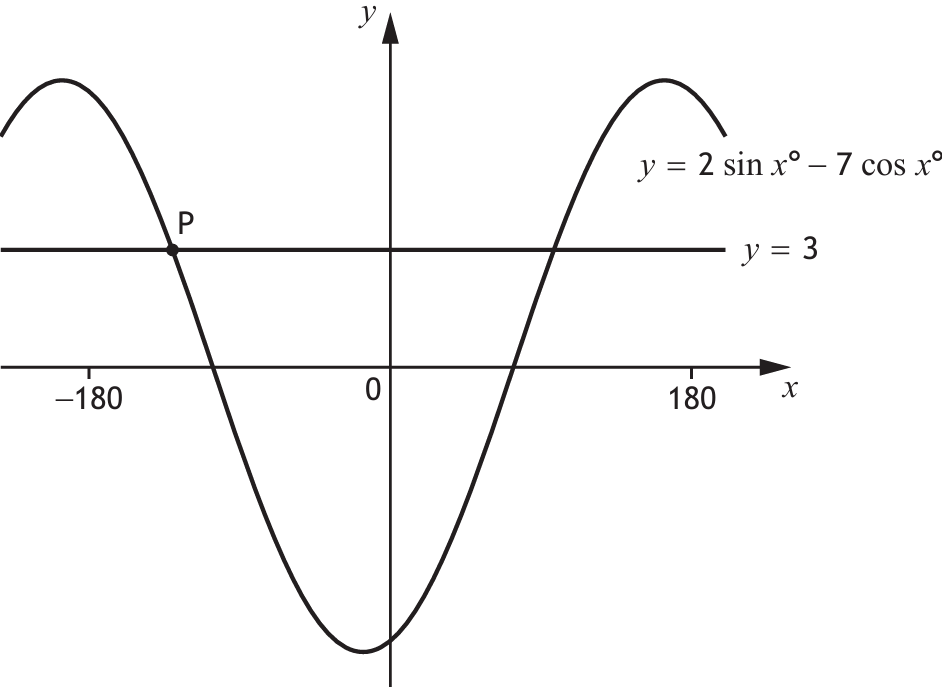
The diagram shows part of the curve with equation \(y=2\sin x^\circ-7\cos x^\circ\) and the line with equation \(y=3\small.\)
The curve and the line intersect at the point P.
(b) Find the \(x\)-coordinate of P.
[Note for ChatGPT: An accompanying diagram shows that P has negative x-coordinate and is the closest intersection point to the origin.]
(a) Expand \(k\sin(x-a)^\circ\) and reorder the factors:
Looking at the diagram, point P lies to the left of the \(y\)-axis, where \(x \lt 0\small.\) So we subtract \(360^\circ\) from our solutions to find the corresponding negative angles:
Express \((3\sin\theta+\cos\theta)(\sin\theta+3\cos\theta)\) in the form \(a+b\sin c\theta\small,\) where \(a\small,\) \(b\) and \(c\) are integers.
First, we expand the brackets and group like terms. Then we use the trig identities \(\sin^2\theta+\cos^2\theta=1\) and \(\sin 2\theta=2\sin\theta\cos\theta\) to write the expression in the required form.





 Zeta Higher Mathematics